Bitcoin: The Cycle-Defining Retest
What a 100-day acceleration could mean for the months ahead
Welcome to the Rekt Capital Newsletter, a resource for investors who want to better navigate the crypto markets with the help of cutting-edge crypto research and unbiased market analysis.
The Retest That Could Define The Cycle
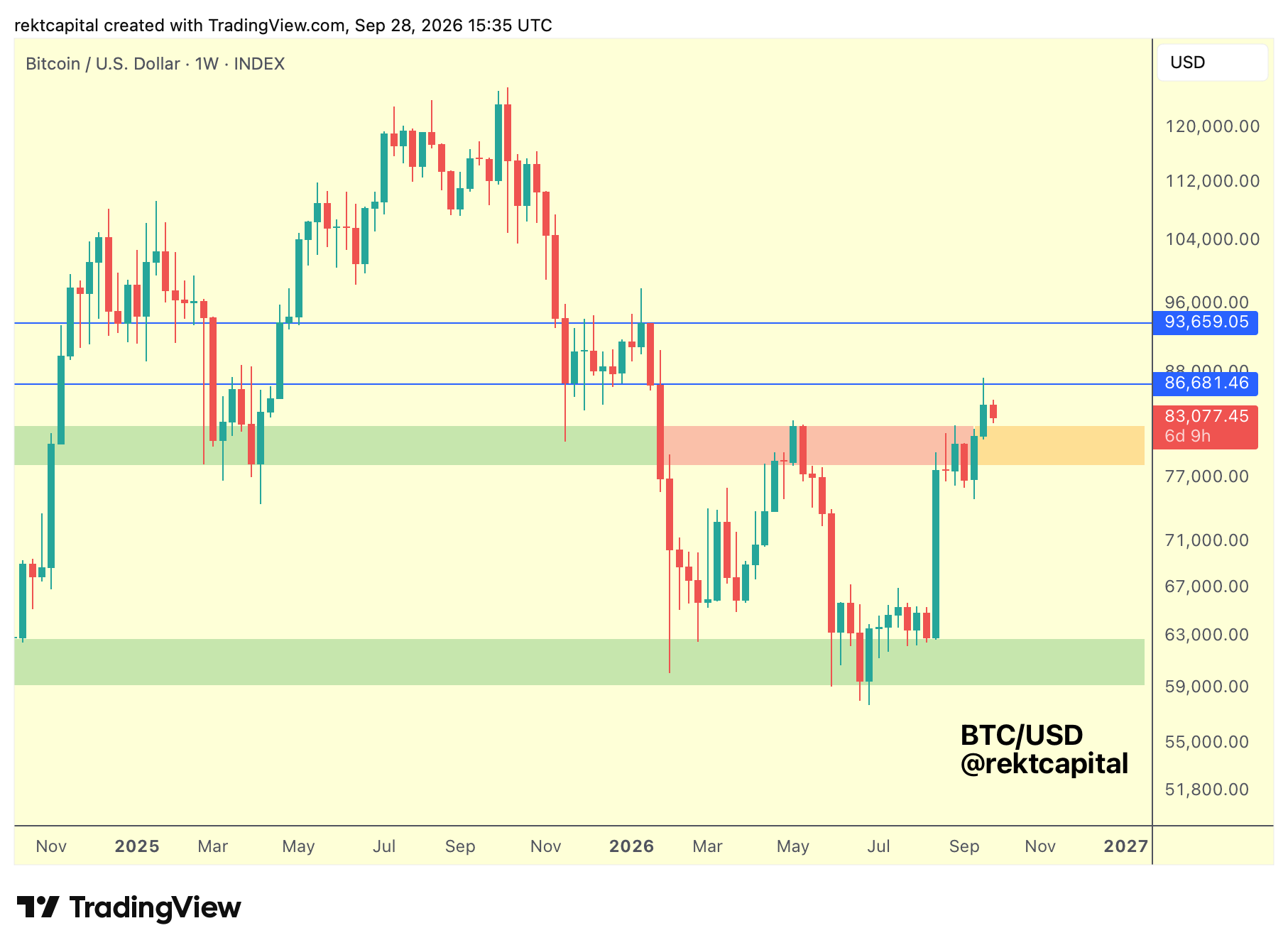
Starting on the Weekly, Bitcoin's Macro Range stretches from roughly $58k (green zone, Range Low) to $82,530 (orange zone, Range High resistance).
Just as the price cluster above ~$80k which outlined the 2025 Bull Market peak marked Bitcoin's Distribution Range, this Macro Range can be thought of as Bitcoin's potential Accumulation Range.
And most recently, Bitcoin has Weekly Closed above the Range High of that Macro Range from $60k-$80k and price is now Post-Breakout Retesting the Range High into newfound support.
A successful retest would technically confirm that price is exiting its $60k-$80k home, the range-bound environment it has developed and evolved within throughout 2026 thus far.
Should Bitcoin fully confirm the breakout from the Macro Range of $60k-$80k, price could then appreciate and, at some point, develop a new Re-Accumulation Range at new highs beyond the orange zone.
That makes this current retest trend-defining, cycle-defining and outcome-reducing, because success would mean Bull Market trend continuation and a new phase in this early-stage cycle.
Price is quite literally in transition.
The market is still coming to grips with the predominant trend, and the question is whether Bitcoin is transitioning into a full blown Bull Market.
A confirmed breakout would deliver exactly that.
Failing the breakout, however, would mark a fakeout and a reversion back into the Macro Range, the Accumulation Range that has been the home for BTC all year thus far.
Bitcoin would resume its macro consolidation between $60k and $80k within which it had been swinging sinusoidally between the Range Low and the Range High; a failed post-breakout retest would result in mean reversion into this range for additional consolidation which would form a new cluster of price action below ~$80k.
That next cluster of range-bound behaviour could take the guise of a Right Shoulder:
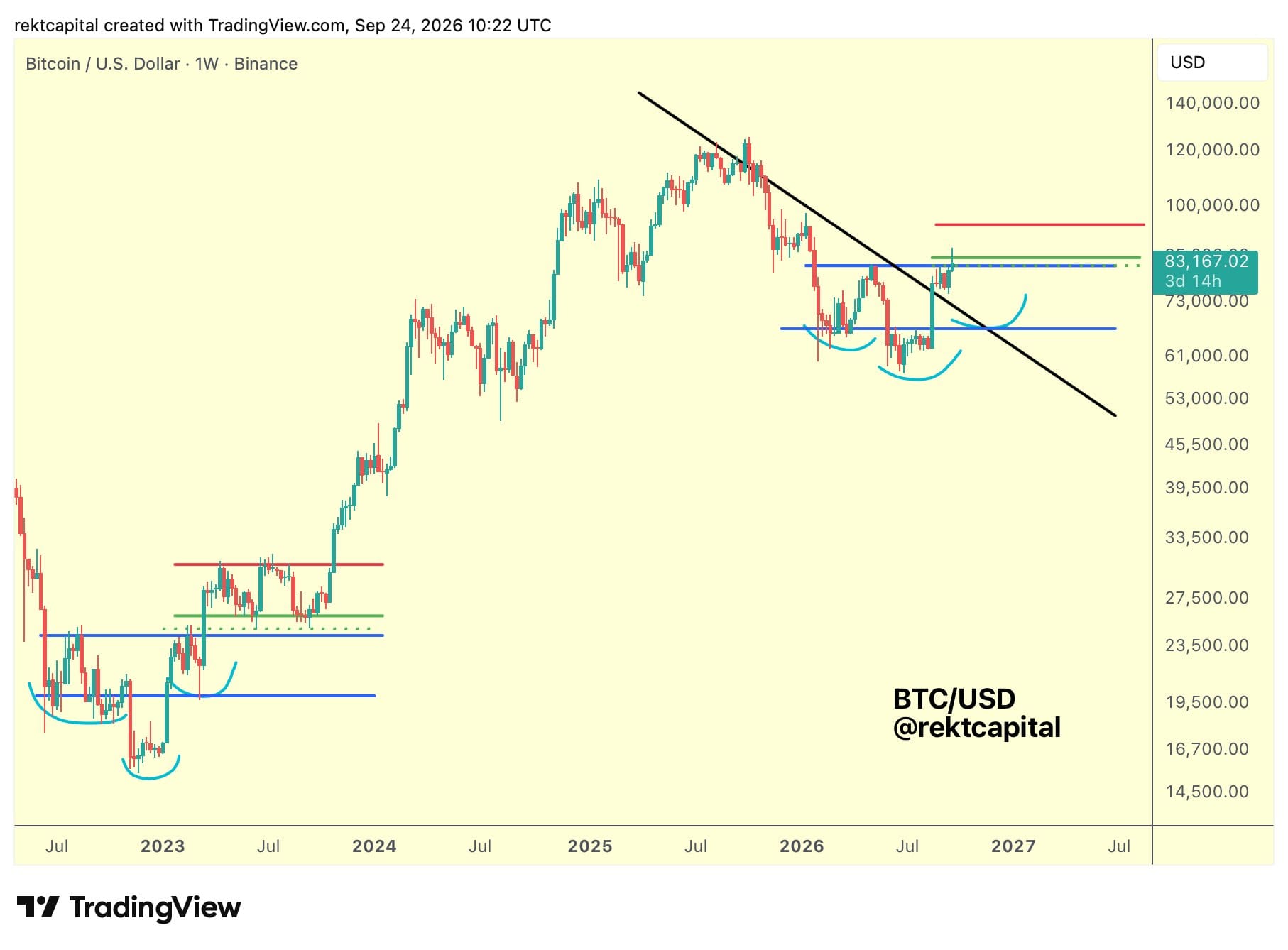
With a Left Shoulder and a Head cluster already in place, that would shape a potential Head and Shoulders structure.
Exiting the range also matters for the cycle, as it would effectively mean Bitcoin wouldn't resynchronise with the Four-Year Cycle at this very specific phase that is the transition from Bear Market bottom to early Bull Market stage.
After all, the Bear Market bottom, the transition to early-bull cycle, the Bull Market peak - these are three of multiple phases in the Four-Year Cycle.
Acceleration in one phase can be reduced in a later one, either via additional consolidation that is prolonged by historical standards or via a very long corrective period.
In 2024, an eight-month consolidation after new All Time Highs in the pre-halving period reduced a 260-day acceleration all the way to zero.
As a result, Bitcoin topped right on time in October 2025, as per the traditional halving and Four-Year Cycles.
So does a new bottom taking place a little sooner completely invalidate the Four-Year Cycle forever?
Today's acceleration is ~100 days, which in all honesty would be a little easier to reduce than the 260 days already erased once before.
So rather than throwing a longstanding market cycle principle out the window after just 100 days, it is important to keep the possibility of Four-Year Cycle resynchronisation in mind.
And I don't say this as someone who is clutching at straws to keep the 4-Year Cycle idea alive at all cost (I actually don't mind if it's invalidated) but as someone who called Cycle Acceleration in May 2024, one month after the new Pre-Halving All Time High, and watched Cycle Acceleration in real-time get reduced to 0 to resynchronise with the 4-Year Cycle by October 2025.